FILTERS
Shilajit Resin vs. Tablets: Which One Should You Choose?
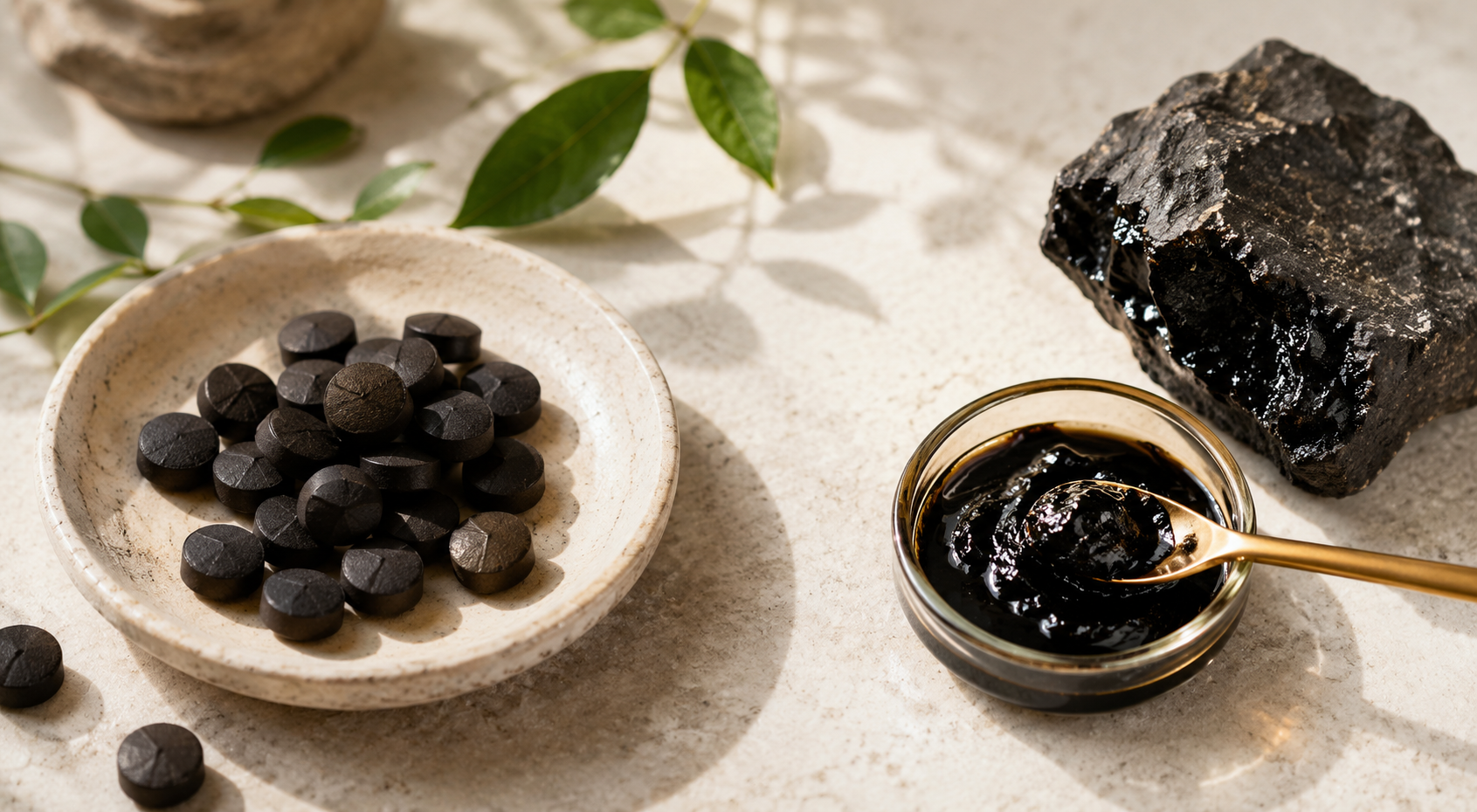
Shilajit resin is the traditional, semi-solid form, while shilajit tablets are more convenient, pre-measured, and easier to use daily. The better choice depends on your priority: traditional use and minimal processing, or convenience and dosage control. Always choose purified, lab-tested shilajit from a trusted source.
Shilajit has been used in Ayurveda as a rasayana, or rejuvenative substance, for strength, stamina, vitality, and overall wellness. Today, it is commonly available in two popular forms: resin and tablets.
Resin is often seen as closer to the traditional form. Tablets are preferred by people who want a simple, fixed-dose supplement that is easier to carry and consume.
But the real question is not only whether shilajit resin or tablets are better. The more important question is whether the product is purified, authentic, lab-tested, and suitable for your body.
TL;DR – Shilajit Resin vs Tablets
- Resin Feels More Traditional: Shilajit resin is sticky, semi-solid, earthy in taste, and usually dissolved in warm water or milk before use.
- Tablets Are Easier Daily: Shilajit tablets are pre-measured, travel-friendly, taste-neutral, and better for people who want convenience and dosage control.
- Quality Matters More Than Form: Resin is not automatically better; purified, authentic, lab-tested shilajit from a trusted source is the real priority.
- Ayurveda Sees Shilajit as Rasayana: It is traditionally used for strength, stamina, energy, vitality, rejuvenation, tissue nourishment, and healthy ageing.
- Use With Caution: People with acidity, high Pitta, pregnancy, breastfeeding, chronic illness, medication use, or inflammatory conditions should consult a practitioner before taking shilajit.
What Is Shilajit Resin?
Shilajit resin is the sticky, semi-solid form of purified shilajit. It is considered closer to the traditional form and is usually dissolved in warm water, milk, or another suitable drink before use.
Shilajit resin has a thick, tar-like texture and a strong, earthy taste. Because it is usually less processed than tablets, many people associate it with purity and traditional Ayurvedic use.
However, resin is not automatically better just because it looks close to its natural form. The quality of resin depends on purification, sourcing, testing, storage, and authenticity.
What Makes Shilajit Resin Different?
Shilajit resin is different because of its texture, taste, and method of use. It is:
- Sticky and semi-solid
- Strong in taste
- Usually dissolved before consumption
- More traditional in feel
- Less convenient than tablets
- More sensitive to storage conditions
Shilajit resin must be stored properly in an airtight container, away from heat, moisture, and direct sunlight. If not stored well, its texture may change and the product may become difficult to use.
What Are Shilajit Tablets?
Shilajit tablets are a convenient form of purified shilajit made into fixed-dose tablets. They are easier to carry, taste-neutral, and suitable for people who want a simple daily routine without measuring resin.
Each tablet usually contains a fixed quantity of shilajit or shilajit extract. This makes the dosage easier to follow compared to resin, where the user has to measure the quantity manually.
Shilajit tablets are useful for people who:
- Want a fixed dosage
- Do not like the strong taste of resin
- Travel often
- Prefer a simple routine
- Are new to shilajit
- Want something easy to take daily
Because tablets are pre-measured, they reduce the guesswork involved in daily use. However, tablets may include excipients, binders, or processing aids used during manufacturing. This is why label reading is important.
What Is the Main Difference Between Shilajit Tablets and Resin?
The main difference between shilajit tablets and resin is form and convenience. Resin is closer to the traditional form and may appeal to users seeking minimal processing, while tablets are easier to dose, carry, and consume consistently.
|
Factor |
Shilajit Resin |
Shilajit Tablets |
|
Form |
Sticky semi-solid resin |
Solid tablet |
|
Convenience |
Lower |
Higher |
|
Taste |
Strong and earthy |
Usually neutral |
|
Dosage |
Needs measuring |
Pre-measured |
|
Travel-friendly |
Less convenient |
More convenient |
|
Traditional feel |
Stronger |
Moderate |
|
Beginner-friendly |
Moderate |
High |
|
Storage |
Needs careful storage |
Easier to store |
|
Daily routine |
Takes more effort |
Easier to follow |
If you want a traditional experience, resin may appeal to you. If you want convenience and consistency, tablets are usually easier.
Is Shilajit Resin Better Than Tablets?
Shilajit resin may be preferred by people who want a more traditional form, but it is not automatically better than tablets.Quality depends on purification, sourcing, and testing, not just whether the product is a capsule or a tablet.
Many people assume resin is better because it appears more natural and less processed. This can be true in some cases, but it is not a guarantee.
A good tablet made with purified, lab-tested shilajit may be more reliable than poor-quality resin. Similarly, high-quality resin may be preferred by people who want a traditional form and do not mind measuring it.
Why Resin Is Often Preferred
People may prefer resin because:
- It feels closer to traditional use
- It is less processed in appearance
- It does not usually require tablet binders
- It has a stronger natural taste and smell
- It gives a ritual-like preparation experience
Why Resin Is Not Always Better
Resin is not always better because:
- Fake resin-like products exist
- The taste may be difficult for beginners
- Dosage can be inconsistent if not measured properly
- Storage needs more care
- Purity cannot be judged by appearance alone
Some products may make strong claims about fulvic acid or mineral content. Do not rely only on marketing claims. Look for genuine lab reports, batch testing, and clear labelling.
Are Shilajit Tablets Effective?
Shilajit tablets can be effective when they contain purified, authentic, and properly processed shilajit. Their main advantage is convenience, fixed dosage, portability, and easier daily use.
Tablets are especially useful for people who want a supplement they can take without preparation. They are easier to include in a morning or evening routine.
Shilajit tablets may be a better fit if:
- You are a beginner
- You do not like strong earthy taste
- You want fixed dosage
- You travel often
- You want less mess
- You prefer quick consumption
The effectiveness of tablets depends on the quality of the shilajit used, the dose, the formulation, and whether the product is purified and tested.
Which Form of Shilajit Is Easier to Use Daily?
Shilajit tablets are easier to use daily because they are pre-measured, portable, and do not require mixing. Resin takes more effort because it must be measured and dissolved before use.
For busy users, tablets are usually more practical. They can be taken with water or milk according to the product label.
Resin is better suited for people who do not mind a traditional routine. It takes a little more time because you need to take the correct quantity, dissolve it properly, and store the jar carefully after use.
Morning Routine Comparison
|
Routine Factor |
Resin |
Tablet |
|
Time needed |
More |
Less |
|
Preparation |
Needs dissolving |
No preparation |
|
Taste |
Strong |
Mild or neutral |
|
Dose control |
Manual |
Pre-measured |
|
Travel use |
Less convenient |
Very convenient |
|
Beginner use |
Moderate |
Easy |
If consistency is your main challenge, tablets may be better. If traditional preparation matters more, resin may be your choice.
How Do You Take Shilajit Resin?
Shilajit resin is usually taken by dissolving a small recommended quantity in warm water, milk, or another suitable drink. It should be used only as per the product label or practitioner advice.
General steps:
- Take the recommended quantity of purified shilajit resin.
- Dissolve it in warm water, milk, or another suitable drink.
- Stir until it mixes well.
- Drink as directed on the product label.
- Do not exceed the suggested dosage.
Avoid boiling shilajit directly. Excessive heat may affect the quality of the preparation. Use warm liquid, not boiling liquid.
Do not guess the dosage. Follow the label or consult an Ayurvedic physician.
How Do You Take Shilajit Tablets?
Shilajit tablets are usually taken with water or milk as directed on the product label. Since tablets are pre-measured, they are easier to include in a daily wellness routine.
General steps:
- Read the product label.
- Take the recommended number of tablets.
- Consume with water or milk, as directed.
- Do not exceed the suggested daily intake.
- Stop use if you experience discomfort.
The best time to take shilajit can depend on your purpose, body type, digestion, and the product formulation. Some people prefer taking it in the morning, while others may take it as advised by a practitioner.
What Are the Benefits of Shilajit in Ayurveda?
In Ayurveda, shilajit is traditionally used as a rasayana to support strength, stamina, energy, vitality, and overall rejuvenation. Its use depends on body type, health condition, digestion, season, and proper purification.
Shilajit is not just positioned as a men’s wellness ingredient in Ayurveda. Traditionally, it is considered a broad rejuvenative substance that supports overall vitality when used appropriately.
Why Is Shilajit Considered a Rasayana?
A rasayana is a rejuvenative substance in Ayurveda. Shilajit is traditionally used to support:
- Strength
- Stamina
- Energy
- Vitality
- Rejuvenation
- Tissue nourishment
- Healthy ageing
- General wellness
These benefits should be understood as traditional Ayurvedic uses, not as guaranteed medical outcomes.
What Does Ayurveda Say About Shilajit’s Properties?
In Ayurveda, shilajit is described as having multiple tastes, including pungent, bitter, salty, and astringent. It is generally considered heating in nature.
Because of this heating quality, it may support Vata and Kapha-related concerns but may aggravate Pitta if taken excessively or without guidance.
This is why people with acidity, heat, burning sensation, inflammatory conditions, or Pitta imbalance should use shilajit carefully.
What Body Systems Is Shilajit Traditionally Associated With?
In Ayurveda, shilajit is traditionally associated with several srotas, or channels, and dhatus, or tissue layers.
It is often discussed in relation to:
- Energy and stamina
- Urinary system support
- Reproductive tissue nourishment
- Bone and tissue strength
- Metabolic balance
- General rejuvenation
- Natural cleansing and tissue support
These are traditional Ayurvedic perspectives. Anyone using shilajit for a specific health condition should consult a qualified practitioner.
Why Is Shilajit Called a Yogavahi?
In Ayurveda, shilajit is sometimes described as a Yogvahi (Yogavahi) ,refers to a substance or property that acts as a bio-enhancer or catalyst, meaning it increases the therapeutic efficacy, absorption, and targeted delivery of other medicines without losing or altering its own core nature.
Because of this, shilajit may be used alongside other herbs or supplements in Ayurvedic practice. However, combinations should be chosen carefully and not taken randomly.
Also Check Out Shilajit Benefits for Women–>
How Should You Choose Between Shilajit Tablets and Resin?
Choose shilajit resin if you prefer traditional preparation and do not mind the taste or measuring process. Choose shilajit tablets if you want convenience, fixed dosage, travel-friendly use, and easier daily consistency.
|
Choose Shilajit Resin If You Want |
Choose Shilajit Tablets If You Want |
|
Traditional form |
Convenience |
|
Minimal processing feel |
Fixed dosage |
|
Ritual-based use |
Travel-friendly option |
|
Strong earthy taste is okay |
Taste-neutral use |
|
You can measure properly |
Beginner-friendly format |
|
You do not mind preparation |
No mixing or measuring |
|
You can store it carefully |
Easy storage |
The final decision should depend on lifestyle, taste preference, dosage comfort, product quality, and practitioner advice.
What Should You Check Before Buying Shilajit?
Before buying shilajit, check whether it is purified, lab-tested, clearly labelled, and made by a trusted brand. Avoid raw, untested, suspiciously cheap, or exaggerated products.
A good shilajit product should clearly show:
- Purification details
- Lab testing
- Batch information
- Ingredient list
- Recommended dosage
- Form of shilajit used
- Brand credibility
- Storage instructions
- No exaggerated claims
Avoid products that promise instant strength, guaranteed testosterone boost, quick weight loss, or miracle results. Shilajit is a traditional wellness ingredient, not a shortcut or cure-all.
Who Should Be Careful While Taking Shilajit?
People with medical conditions, pregnancy, breastfeeding, high Pitta symptoms, acidity, chronic illness, or those taking medication should consult a doctor or Ayurvedic practitioner before taking shilajit.
Use caution if you have:
- Acidity or burning sensation
- High body heat
- Pitta aggravation
- Pregnancy or breastfeeding
- Chronic kidney, liver, or heart conditions
- Ongoing medication use
- Known mineral imbalance
- Allergy or sensitivity
- Active inflammatory conditions
Children should take shilajit only under professional guidance.
Never consume raw or unpurified shilajit.
What Is the Final Takeaway on Shilajit Tablets vs Resin?
Shilajit resin and tablets both have value. Resin is closer to the traditional form and may appeal to people who prefer ritual-based use. Tablets are easier, cleaner, pre-measured, and better for daily consistency.
Choose resin if you want a traditional form and do not mind the strong taste or measuring process. Choose tablets if you want convenience, fixed dosage, and travel-friendly use.
Popular Posts

Varicose Veins Symptoms: Causes, Early Signs and Ayurvedic Management
05 Oct, 2026Varicose veins are enlarged, twisted veins that commonly appear on the legs, feet, and ankles, o...
Read more
Himalayan Pink Salt Benefits: Uses, Nutrition and What to Know
29 Sep, 2026A pinch of salt seems simple, yet Ayurveda has always looked closely at simple things: their tas...
Read more
Plaque vs Tartar: What Is the Difference and How Does Ayurveda Approach Them?
28 Sep, 2026Plaque is a soft, sticky film of bacteria that forms on teeth, while tartar is hardened or calci...
Read more