FILTERS
The Great Ghee Deception: What’s Really in Your “Pure Ghee”?

Walk into any Indian kitchen and you'll find a jar of ghee sitting proudly on the shelf, golden, aromatic, and trusted like family. For generations, ghee, India's beloved clarified butter, has been more than food. It's been medicine, ritual, and comfort in a spoon. But somewhere between grandma's kitchen and the supermarket aisle, something changed. The ghee we buy today often isn't the ghee our grandparents knew. It's been diluted, cut, blended, and dressed up in packaging that says "pure" while the ingredient list tells a very different story.
This is the story of how ghee lost its purity, and how you, as a buyer, can get it back.
The Silent Swap: Palm Oil and Vegetable Oil in Your Ghee Jar
Pure cow ghee has exactly one ingredient: milk fat, slow-cooked until the water evaporates and the milk solids caramelise into that nutty aroma we all recognise. That's it. No additives, no blends, no shortcuts.
But ghee is expensive to make properly. It takes a lot of milk, a lot of time, and a lot of patience. So somewhere along the industrial supply chain, manufacturers discovered a cheaper way to fill the jar, blend real ghee with refined palm oil, vegetable oil, or hydrogenated fats (commonly called vanaspati). These oils are cheap, shelf-stable, and can be flavoured and coloured to mimic real cow ghee almost convincingly.
The result looks like ghee, smells vaguely like ghee, and is sold at a price that seems too good to be true, because it is. What you're consuming isn't the nutrient-dense, digestive, immunity-supporting fat your body recognises. It's a cocktail of industrial oils wearing a ghee costume.
Why This Matters More Than You Think
This isn't just about taste or tradition, it's about health, and about protecting the very ghee nutritional value that has made this fat prized for thousands of years. Pure ghee, made correctly, is rich in fat-soluble vitamins (A, D, E, K), butyric acid (which supports gut health), and a balanced profile of healthy fats that the human body has trusted for generations. Adulterated ghee, on the other hand, often carries trans fats and oxidised oils that do the opposite of what real ghee benefits are celebrated for — they strain your heart instead of supporting it.
Good Fat vs. Bad Fat: The Cholesterol Confusion
Ghee has long been credited with supporting healthy cholesterol levels, specifically, contributing to HDL (the "good" cholesterol) that helps clear arteries rather than clog them. This is one of the reasons Ayurveda has revered cow ghee for centuries as a heart-friendly, brain-nourishing fat, valued for kindling Agni (digestive fire) as much as for its nutrition.
But here's the irony: when real ghee is cut with palm oil or vegetable oil, that entire benefit collapses. Refined vegetable oils and palm oil blends are frequently associated with higher LDL ("bad" cholesterol) and inflammatory fats, especially when processed and reheated during manufacturing. So the very product marketed to protect your heart may quietly be working against it not because ghee is bad, but because what's in the jar often isn't ghee at all.
Reading the Label Like a Detective, Not a Shopper
Most of us grab a jar, glance at the word "Pure" or "100% Desi Ghee" on the front, and toss it into the cart. That's exactly what manufacturers count on. Here's how to actually read a ghee label and separate the best ghee from a diluted imitation:
- Check the ingredient list, not the front label. If it says only "milk fat" or "ghee (from cow's milk)," that's a good sign. If you see "vegetable oil," "palm oil," "refined oil," or vague terms like "edible oil blend," put it back.
- Be wary of the word "blended" or "mixed." Some brands are honest enough to call their product a "ghee blend" this is code for adulteration, even if it's technically disclosed.
- Look for FSSAI certification and batch testing details. Genuine cow ghee producers are transparent about lab testing, not just certification logos.
- Ignore price-based assumptions. Cheap doesn't always mean fake, and expensive doesn't always mean pure but a price that's dramatically lower than the cost of producing real ghee from milk should raise questions.
- Marketing words to be sceptical of. "Traditional," "Farm Fresh," "Desi Style," and "Authentic Taste" are marketing phrases, not proof of purity. They describe a feeling, not a fact. What actually matters is the ingredient list and lab testing everything else is packaging poetry.
Organic Ghee: Traditional Ayurvedic Support for Daily Nourishment
A pure, golden ghee traditionally valued in Ayurveda to support digestion, vitality, and everyday wellness routines
Buy Now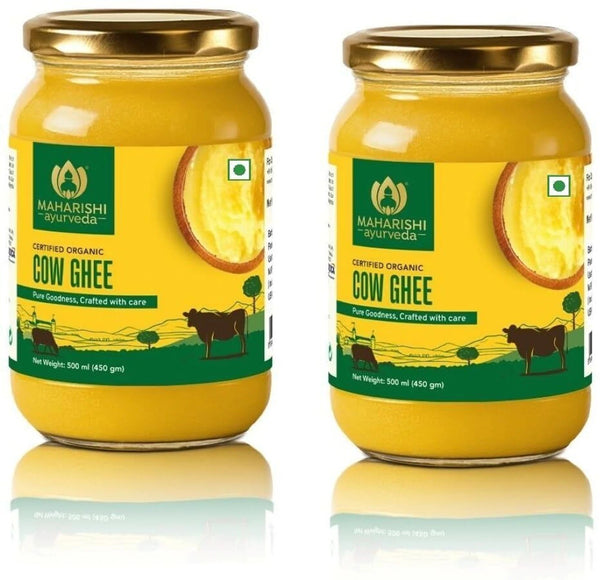
The Beta-Sitosterol Test: A Scientific Way to Catch the Fakes
This is where things get genuinely interesting. One of the most reliable scientific markers used to detect vegetable oil or palm oil adulteration in ghee is testing for Beta-Sitosterol, a plant sterol that is naturally absent in pure milk fat but present in vegetable and palm oils. If a ghee sample tests positive for beta-sitosterol, it's a strong indicator that plant-based oils have been mixed in.
Maharishi Ayurveda's Organic Desi Cow Ghee uses this exact test as a purity benchmark, testing each batch for the absence of Beta-Sitosterol to confirm that the ghee is genuinely 100% milk fat, with no hidden oil blends. It's part of what positions it among the best cow ghee options for buyers who want proof, not just a promise — a small technical detail most consumers never hear about, but one of the few objective, lab-based ways to separate a real ghee from a disguised one, rather than relying on taste, smell, or a trust-me label.
Why Ghee Changes Texture With Temperature (And Why That's Normal)
If you've ever noticed your ghee looking solid in winter, softly grainy in a mild room, and completely liquid in summer heat, you haven't stumbled onto something wrong — you've witnessed pure ghee behaving exactly as it should. Ghee is composed of different types of fat molecules, each with a different melting point. In colder temperatures, the saturated fats solidify, giving ghee a firm, almost butter-like texture. As the temperature rises, it gradually turns semi-solid and grainy, and eventually fully liquid and golden in warmer weather.
This shifting texture is actually one of the quiet signs of purity. Adulterated ghee, loaded with hydrogenated or refined oils, tends to stay uniformly solid or oddly consistent regardless of temperature, because the added oils are engineered to be shelf-stable and texturally "predictable." Real cow ghee, in contrast, breathes and responds to its environment a small but telling clue.
The Bilona Method: How Ghee Was Actually Meant to Be Made
Traditional ghee-making follows what's known as the Bilona method, one of the traditional Ayurvedic practices passed down for generations through a slow, deliberate, hand-churned process. It begins with curd made from full-fat milk, which is then hand-churned using a wooden bilona (churner) to separate the butter from the buttermilk. This fresh butter is then slow-cooked on a low flame until the water content evaporates and the milk solids gently caramelise, releasing that signature nutty aroma pure ghee is known for.
Here's the catch: today, many brands claiming a "traditional" or "bilona" process have quietly changed the actual method while keeping the label. Instead of churning curd into butter and then heating that butter, many manufacturers today take a shortcut: they churn only the malai (the fatty cream layer skimmed off milk) and heat that directly into ghee. This skips the crucial curd-fermentation and butter-churning stages that give ghee its nutritional depth, digestibility, and authentic character.
The result is a product that may still be called "ghee" and even marketed as "traditionally made," but is structurally and nutritionally a shortcut version often described by traditionalists as closer to a "bad fat" concentrate than real, slow-cultured ghee. The process isn't just about following steps for tradition's sake; each stage exists for a biochemical reason, and skipping steps changes what actually ends up in the jar.
The Bottom Line: Trust, But Verify
Ghee isn't just a cooking fat, it's a legacy ingredient wrapped in centuries of trust. But that trust has been quietly exploited by an industry racing toward cheaper production and flashier packaging. The good news is that purity isn't invisible; it just requires a little more attention than a glance at the front label.
Read the ingredients. Question the marketing language. Look for real testing standards like Beta-Sitosterol verification. Understand that texture changes with temperature aren't a flaw they're a feature of the real thing. And most importantly, remember that the word "pure" printed on a jar means nothing unless it's backed by what's actually inside it.
And once you do have a genuine jar in hand, purity is only half the story; how you use it matters too. A traditional practice like taking ghee with warm water each morning, for instance, only delivers its intended ghee with warm water benefits when the ghee itself is real; warm water with ghee made from a palm oil blend offers none of the digestive or nourishing qualities Ayurveda associates with the ritual. The same rule applies everywhere ghee is used, cooking, Ayurvedic preparations, or a simple spoonful with warm water: the benefit only exists if the ghee does.
The next time you reach for a jar of ghee, don't just trust the label, read it like you mean it.
Organic Ghee: Traditional Ayurvedic Support for Daily Nourishment
A pure, golden ghee traditionally valued in Ayurveda to support digestion, vitality, and everyday wellness routines
Buy Now
Popular Posts

Low AMH: What It Means for Fertility
14 Oct, 2026A calm, clear guide for women who have just seen that number on a report. Meera was 32 when the l...
Read more
Varicose Veins Symptoms: Causes, Early Signs and Ayurvedic Management
05 Oct, 2026Varicose veins are enlarged, twisted veins that commonly appear on the legs, feet, and ankles, o...
Read more
Himalayan Pink Salt Benefits: Uses, Nutrition and What to Know
29 Sep, 2026A pinch of salt seems simple, yet Ayurveda has always looked closely at simple things: their tas...
Read more