FILTERS
Is Your Shilajit Real or Fake? How to Test It

Real Shilajit is dark, resin-like, earthy in smell, water-soluble, lab-tested and sourced transparently from high-altitude regions. Fake Shilajit may contain wax, tar, fillers, heavy metals or synthetic additives. Simple checks can help, but the safest way to verify purity is through lab reports and trusted brands.
TL;DR – How to Test Real vs Fake Shilajit
- Real Shilajit Has Clear Signs: Genuine Shilajit is dark, resin-like, earthy in smell, softens with warmth, firms when cooled, and dissolves cleanly in warm water.
- Fake Shilajit Can Be Risky: Low-quality products may contain wax, tar, fillers, heavy metals, synthetic additives, or petroleum-like substances.
- Home Tests Can Help: Water solubility, heat response, alcohol reaction, smell, and texture checks can identify obvious adulteration, but they cannot confirm full purity.
- Lab Testing Is Most Important: Always check for a batch-specific Certificate of Analysis covering heavy metals, microbial safety, fulvic acid, and purity standards.
- Trust the Source, Not Big Claims: Choose purified Shilajit from a credible brand with transparent sourcing, realistic claims, clear lab reports, and proper batch information.
How Can You Tell If Shilajit Is Real or Fake?
You can tell if Shilajit is real by checking its source, texture, smell, water solubility, heat response, alcohol reaction, lab testing and brand credibility. Genuine Shilajit should dissolve in warm water, soften with heat, smell earthy, and come with a proper Certificate of Analysis.
Shilajit is one of Ayurveda’s most valued Rasayana substances. Traditionally, it is known for supporting strength, stamina, vitality and rejuvenation when used correctly. However, its rising popularity has also led to many fake, low-quality and adulterated products in the market.
Fake Shilajit is not just ineffective. It may contain harmful substances such as heavy metals, chemical fillers, coal tar, asphalt, synthetic binders or wax-like substitutes. This is why checking purity before buying or consuming Shilajit is important.
Read our complete guide on shilajit and its benefits —>
Shilajeet Resin: Traditional Ayurvedic Support for Strength & Vitality
A pure Ayurvedic resin traditionally valued to support stamina, energy, and everyday wellness
Buy Now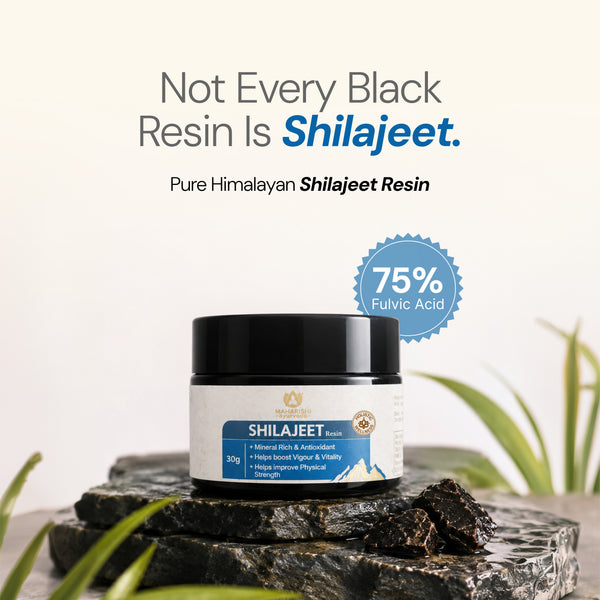
Why Is Fake Shilajit a Serious Concern?
Fake Shilajit is a serious concern because it may contain harmful impurities, heavy metals, wax, tar, fillers or chemical additives. These substances can affect health and do not offer the traditional Ayurvedic value of authentic purified Shilajit.
A low-quality product may look similar to Shilajit but fail basic purity checks. Some counterfeits are made to imitate the colour and texture of real Shilajit resin. Others may be diluted with fillers or sold with misleading claims.
The biggest red flags include:
- No clear source or origin
- No lab report
- Very low price
- Chemical or petroleum-like smell
- Does not dissolve in water
- Burns when exposed to flame
- Claims of instant or guaranteed results
- No mention of purification method
- No heavy metal testing
If a product fails multiple checks, it should not be consumed.
What Is Ozokerite and Why Is It Used as Fake Shilajit?
Ozokerite is a naturally occurring waxy mineral that can look similar to raw Shilajit. It is dark brown to black, waxy in texture and visually convincing, which makes it one of the common substitutes used in fake Shilajit products.
Ozokerite does not offer the traditional Ayurvedic properties of Shilajit. It does not provide the same natural mineral profile or fulvic acid content associated with authentic Shilajit.
How to Identify Ozokerite in Fake Shilajit
Ozokerite may show these signs:
- It burns more easily when exposed to flame.
- It may give a waxy or petroleum-like smell.
- It does not dissolve cleanly in warm water.
- It may float or leave a waxy residue.
- It has little or no earthy mineral smell.
- It may not soften naturally in the hand like genuine Shilajit resin.
If your Shilajit behaves like wax, smells like petroleum, or leaves a greasy film in water, do not consume it.
What Should Real Shilajit Look, Smell and Feel Like?
Real Shilajit is usually dark brown to deep black, smooth, resin-like and slightly sticky. It has a strong earthy, smoky or mineral smell. It softens when warmed in the hand and becomes firmer when cooled.
Authentic Shilajit resin has natural temperature sensitivity. It becomes softer in warmth and harder in cooler conditions. This resin-like behaviour is one of the key signs of genuine Shilajit.
Signs of Real Shilajit
|
Check |
Real Shilajit |
|
Colour |
Dark brown to deep black |
|
Texture |
Smooth, tar-like resin |
|
Smell |
Earthy, smoky or mineral-like |
|
Warmth response |
Softens when warmed |
|
Cooling response |
Firms up again |
|
Water test |
Dissolves in warm water |
|
Flame test |
Bubbles or softens, but should not burn easily |
|
Lab testing |
Comes with purity and heavy metal reports |
Signs of Fake Shilajit
|
Check |
Possible Fake Shilajit |
|
Colour |
Unnaturally glossy black |
|
Texture |
Rubbery, grainy, sandy or waxy |
|
Smell |
Chemical, plastic, tar-like or perfumed |
|
Water test |
Leaves lumps, sediment or oily residue |
|
Flame test |
Burns, smokes or smells like petroleum |
|
Lab testing |
No COA or unclear reports |
|
Price |
Suspiciously cheap |
How to Test Shilajit at Home
You can test Shilajit at home using the water solubility test, heat test, alcohol test, texture check and smell check. These tests can help identify obvious adulteration, but they do not replace third-party lab testing.
Home tests are useful for basic screening. However, only a proper lab report can confirm heavy metal safety, microbial purity and fulvic acid content.
1. How to Do the Shilajit Water Solubility Test
To do the Shilajit water test, drop a small rice-grain-sized piece of Shilajit into warm water. Real Shilajit should dissolve within a few minutes and turn the water dark brown or golden-black without leaving residue.
What Real Shilajit Does in Water
Real Shilajit should:
- Dissolve in warm water
- Spread evenly through the water
- Create a dark brown or golden-black solution
- Leave little to no residue
- Not float like wax
- Not form stubborn lumps
What Fake Shilajit Does in Water
Fake or adulterated Shilajit may:
- Float on the surface
- Leave grainy sediment
- Create oily or waxy residue
- Stay in lumps
- Not dissolve properly
- Leave a film on the water
If the product does not dissolve cleanly in water, treat it as a red flag.
2. How to Do the Shilajit Heat or Flame Test
In the heat test, a small amount of genuine Shilajit may soften and bubble slightly when exposed to heat, but it should not catch fire easily or produce a strong chemical smell. If it burns, smokes or smells like plastic, tar or petroleum, it may be adulterated.
This test should be done with caution. Use only a tiny amount on a metal spoon, keep a safe distance, and do it in a ventilated area.
Real Shilajit During Heat Test
Real Shilajit may:
- Soften
- Bubble slightly
- Become sticky or resin-like
- Return to a firmer form when cooled
- Avoid strong chemical smoke
Fake Shilajit During Heat Test
Fake Shilajit may:
- Catch fire
- Burn quickly
- Produce smoke
- Smell like tar, plastic or petroleum
- Leave burnt residue
Do not consume Shilajit that burns or gives a chemical smell.
3. How to Do the Shilajit Alcohol Test
In the alcohol test, real Shilajit should not dissolve cleanly in alcohol. Place a small amount of Shilajit in rubbing alcohol or ethanol. If it dissolves easily, it may contain additives, synthetic binders or fillers.
This test is especially useful for powders or capsules where texture and heat response are harder to check.
Correct Behaviour
|
Test |
Real Shilajit Behaviour |
|
Warm water |
Dissolves |
|
Alcohol |
Does not dissolve cleanly |
A product that dissolves in water but not in alcohol shows a more typical behaviour of genuine Shilajit.
4. How to Check Shilajit by Smell and Texture
You can check Shilajit by smell and texture. Real Shilajit has a strong earthy, smoky or mineral smell and a smooth resin-like texture. Fake Shilajit may smell chemical, perfumed, rubbery, waxy or petroleum-like.
Texture is important because many fake products imitate the colour but not the natural behaviour of Shilajit resin.
Avoid products that feel:
- Sandy
- Grainy
- Rubbery
- Waxy
- Too glossy
- Like industrial glue
- Artificially scented
A natural strong smell is acceptable. A chemical or synthetic smell is not.
5. Why Lab Testing Is the Most Important Shilajit Purity Check
Lab testing is the most important Shilajit purity check because home tests cannot confirm heavy metals, microbial contamination, synthetic fillers or exact fulvic acid content. Always choose Shilajit that provides a Certificate of Analysis.
A good Certificate of Analysis should show testing for:
- Lead
- Mercury
- Cadmium
- Arsenic
- Microbial contamination
- Yeast and mould
- Fulvic acid content
- Purity and safety standards
Shilajit is sourced from rocks, so heavy metal testing is especially important. Never buy Shilajit from brands that do not provide safety testing.
What Fulvic Acid Percentage Should Real Shilajit Have?
Authentic Shilajit should mention fulvic acid content on its lab report, but higher is not always better. Be careful with products claiming extremely high fulvic acid percentages without a complete mineral profile or third-party verification.
Many buyers assume that 90% or 100% fulvic acid means better Shilajit. This can be misleading. Very high fulvic acid claims may suggest chemical concentration, isolated fulvic acid, or inaccurate labelling.
A trustworthy product should provide:
- Fulvic acid percentage
- Mineral profile
- Heavy metal test results
- Microbial safety report
- Batch-specific COA
Whole Shilajit is valued for its natural combination of fulvic acid, humic substances, minerals and other bioactive compounds. It should not be judged by fulvic acid percentage alone.
How Important Is the Source and Origin of Shilajit?
The source of Shilajit is very important. Genuine Shilajit is traditionally sourced from high-altitude mountain regions such as the Himalayas, Altai Mountains or Gilgit-Baltistan. A trusted brand should clearly mention the origin, sourcing region and purification process.
A vague label such as “Himalayan Shilajit” without details is not enough.
Look for information such as:
- Exact sourcing region
- Altitude
- Rock type or grade, if available
- Purification method
- Testing standards
- Batch traceability
- Ethical sourcing practices
Transparent sourcing is a strong sign of brand credibility.
What Are the Different Grades of Shilajit?
Ayurvedic tradition describes different grades of Shilajit based on the colour of the rocks from which it is extracted. These include gold, iron, silver and brown grades. However, all genuine grades should still pass basic purity and safety checks.
|
Shilajit Grade |
Rock Colour |
General Note |
|
Gold Grade |
Red or gold rocks |
Traditionally considered the highest quality |
|
Iron Grade |
Black rocks |
Common commercial grade |
|
Silver Grade |
Grey rocks |
Less commonly available |
|
Brown Grade |
Brown rocks |
Lower grade in traditional classification |
A product claiming to be premium should be transparent about sourcing. However, grade alone is not enough. Lab testing and purity matter more than marketing claims.
How Can Brand Credibility Help Identify Real Shilajit?
Brand credibility helps identify real Shilajit because trusted brands provide sourcing details, lab reports, safety certifications, customer support and realistic product information. Fake brands often rely on heavy discounts, exaggerated promises and vague claims.
Before buying, check:
- Does the brand provide a COA?
- Is the COA batch-specific?
- Are heavy metals tested?
- Is the source clearly mentioned?
- Is the purification method explained?
- Are certifications shown?
- Are reviews verified?
- Does the brand avoid miracle claims?
- Is the price realistic?
Be careful with claims such as “instant results,” “miracle cure,” “100% guaranteed effects,” or “90 to 100% fulvic acid.” These are common red flags.
Why Is Real Shilajit Expensive?
Real Shilajit is expensive because it is rare, difficult to source and requires careful purification and testing. Authentic Shilajit comes from remote mountain regions and must be processed properly before use.
If Shilajit is extremely cheap, it may be diluted, low-grade, adulterated or fake.
A higher price does not always guarantee purity, but a very low price is a warning sign. Always compare price with lab reports, sourcing details and brand credibility.
What Should You Do If Your Shilajit Fails the Test?
If your Shilajit fails one or more purity checks, stop using it immediately. Do not continue consuming a product that burns, smells chemical, leaves residue, does not dissolve in water or has no lab report.
Follow these steps:
- Stop using the product.
- Keep the packaging and batch number.
- Take photos or videos of the failed test.
- Contact the seller or brand.
- Request lab reports if not already provided.
- Ask for a refund if quality is doubtful.
- Report the product on the marketplace if needed.
- Choose a verified replacement with proper testing.
Do not try to “finish the bottle” if the product appears fake or unsafe.
Real vs Fake Shilajit: Quick Comparison
|
Feature |
Real Shilajit |
Fake Shilajit |
|
Colour |
Dark brown to black |
Too glossy or artificial black |
|
Smell |
Earthy, smoky, mineral-like |
Chemical, tar-like or perfumed |
|
Texture |
Smooth resin |
Waxy, sandy, rubbery or sticky like glue |
|
Warm water test |
Dissolves cleanly |
Leaves residue, floats or forms lumps |
|
Alcohol test |
Does not dissolve cleanly |
May dissolve due to binders |
|
Flame test |
Softens or bubbles |
Burns, smokes or smells chemical |
|
Lab report |
Available and batch-specific |
Missing or vague |
|
Source |
Clearly mentioned |
Vague or absent |
|
Price |
Usually premium |
Suspiciously cheap |
|
Claims |
Realistic wellness support |
Miracle or instant-result claims |
Shilajeet Resin: Traditional Ayurvedic Support for Strength & Vitality
A pure Ayurvedic resin traditionally valued to support stamina, energy, and everyday wellness
Buy Now
Final Takeaway
Real Shilajit should be sourced transparently, purified properly, tested for safety and supported by a Certificate of Analysis. It should dissolve in warm water, smell earthy, soften with warmth and avoid chemical or petroleum-like behaviour.
Home tests can help you identify obvious fake Shilajit, but they are not a replacement for lab testing. Always choose Shilajit from a trusted brand that provides batch-specific reports, realistic claims and clear sourcing details.
Before taking any Shilajit product, make sure it is genuine, purified and tested for heavy metals and contaminants.
Shop Maharishi Ayurveda's pure Shilajeet Resin
Read More
Shilajit Resin vs. Tablets: Which One Should You Choose?
Shilajit Benefits for Women: Can This Superfood Boost Your Health?
Popular Posts

What Is Metabolic Health and Why Does It Matter for Weight Management?
15 Oct, 2026Metabolic health refers to how effectively the body manages blood sugar, blood pressure, blood fa...
Read more
Low AMH: What It Means for Fertility
14 Oct, 2026A calm, clear guide for women who have just seen that number on a report. Meera was 32 when the l...
Read more
Varicose Veins Symptoms: Causes, Early Signs and Ayurvedic Management
05 Oct, 2026Varicose veins are enlarged, twisted veins that commonly appear on the legs, feet, and ankles, o...
Read moreRecommended Products